
NFC ID card chip: data, security and concrete uses
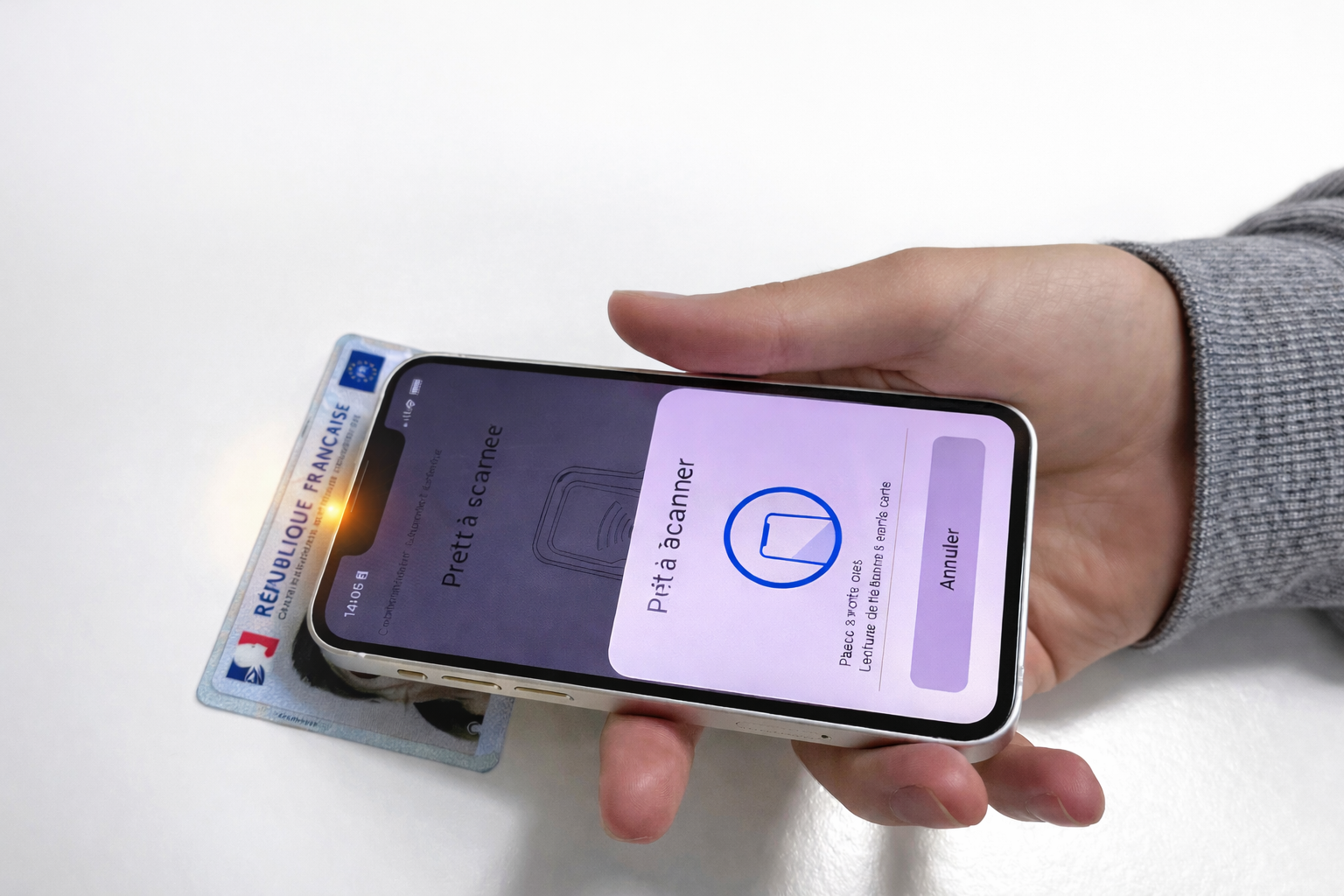
Since August 2021, the new national electronic identity card integrates a secure NFC chip. This evolution raises a number of questions among citizens:What data is stored? Can the chip be hacked? Is it trackable? What is it used for on a daily basis in concrete terms?In this article, we take stock of how the NFC chip works, its security, its uses, as well as the legal framework that governs it.
Key points to remember
- Since August 2, 2021, the new national identity card in bank card format integrates a secure NFC chip, an electronic component that complies with European standards.
- The chip stores personal and biometric data (photo, fingerprints for ages 12 and over), protected by several cryptographic layers.
- No geolocation device is present in the chip: it is impossible to track your movements via your identity card.
- The main uses include reinforced identity control, the fight against document fraud, and online authentication via the France Identité application to access your digital identity.
What is the NFC chip on a French identity card?
The new French identity card, officially called the “national electronic identity card” (CNIe), marks a major evolution in the management of identity documents in France. Since August 2, 2021, this identity document in bank card format has incorporated technology that is transforming the way in which French citizens prove their identity.
- Definition of CNIe : The national electronic identity card is issued by the Ministry of the Interior via the equipped town halls. It is gradually replacing the older cards in larger format.
- NFC technology : The acronym NFC stands for Near Field Communication, or “near field communication”. This technology allows a contactless exchange of data between the chip and a compatible reader, but only at a very short distance (a few centimeters maximum).
- A secure electronic component : The integrated chip complies with regulation (EU) 2019/1157 and international ICAO standards (ICAO Doc 9303). These standards ensure interoperability with control systems around the world.
- Reading the chip : Only compatible devices can access information: law enforcement terminals, border terminals, or your smartphone equipped with the official France Identité application.

What data is stored in the NFC chip on the ID card?
Not all of the information visible on your ID is necessarily duplicated on the chip. However, the essential data is in numerical and encrypted form.
Civil status data
The bullet contains all the information relating to your marital status:Data typeDetailDetailName and first namesFull identity of the holderDate and place of birthBirth informationExemption legalNationalityFrench nationalityFrench NumberTitle numberTitle numberUnique card identifierDate of issuance and validityDocument validity period
Biometric data
- Digitized photography : A high-resolution image of your face is stored to allow biometric verification during checks.
- Fingerprints : In accordance with Regulation (EU) 2019/1157, fingerprints of two fingers are registered for anyone aged 12 and over.
Technical safety data
The chip also includes elements that are essential for its secure operation:
- Electronic certificates issued by the French State
- Cryptographic signature keys
- Document serial numbers
All of this data is encrypted and digitally signed by the French State, making any fraudulent modification or copy detectable.
How is this data protected?
The security of your identity card is based on several layers of protection superimposed on each other. These mechanisms, which comply with ICAO 9303, prevent unauthorized reading and ensure the integrity of the information.
Basic Access Control (BAC)
The first level of protection requires information present on the physical card to initiate a connection with the chip:
- The reader should know the document number and/or the data of the MRZ zone
- This requirement prevents any “wild” reading from a distance by a stranger.
- An encrypted session key is generated to secure the exchange
However, security expert Renaud Lifchitz has shown that the entropy of BAC remains relatively low: under controlled conditions, an attacker with time could theoretically break this protection by brute force in a few minutes.
PACE protocol
To overcome BAC's weaknesses, the PACE protocol (Password Authenticated Connection Establishment) offers reinforced protection:
- Use the six-digit CAN (Card Access Number) visible on the front
- Based on a password-authenticated Diffie-Hellman exchange
- Resists brute-force attacks effectively thanks to higher entropy
Extended Access Control (EAC)
Access to sensitive biometric data such as fingerprints requires an additional level of security:
- Mutual authentication via electronic certificates
- Only terminals that are officially certified and authorized by the state can access this data.
- The terminal must prove its authorization, and the card proves its authenticity
This entire system complies with European requirements in terms of data protection and privacy.

Can you hack an ID card's NFC chip?
The issue of security in the face of hacking attempts deserves a clear focus.
- Very limited range : NFC technology works at a maximum distance of about 20 centimeters. Reading the chip remotely without physically owning the card is extremely difficult in practice.
- Encrypted and signed data : Even if intercepted, a hacker cannot change the information without automatic verification detecting the forgery.
- Brute force attack on the BAC : Theoretically possible, but the attacker must already have the card in hand for several minutes, which greatly limits the value of such an attack.
- Enhanced fingerprint protection : Thanks to Extended Access Control, only state-approved devices can access biometric data. No mainstream application can read them.
Does the NFC chip allow citizens to be traced or geolocated?
This question comes up frequently among users concerned about their privacy. The answer is clear and reassuring.No geolocation device is integrated into the NFC chip on your identity card.Here's what you need to understand:
- The chip does not contain GPS or active signal transmitters
- It only emits when a compatible reader is placed a few centimeters away, by electromagnetic induction
- The State cannot track your movements via this chip, nor can it constitute a history of your trips
The design of the chip and the protocols respect the GDPR and the principle of data minimization. Only the information strictly necessary for identification is stored. As for the official readings of the chip (police check, border crossing), they are regulated by law and must meet a legal reason for identity control.
What is the practical purpose of the NFC chip on an identity card?
The uses of this new generation of identity cards are multiplying, in France and internationally.
Fight against document fraud
The chip allows automatic comparison between the data visible on the card and the data digitally signed by the State. This verification makes forgery virtually impossible.
Border controls
In airports and checkpoints, reading the chip speeds up procedures:
- Instant verification of the authenticity of the title
- Concordance between the holder and the biometric data
- Interoperability with systems in EU countries and beyond
Checks by law enforcement agencies
Law enforcement agencies in France have secure mobile terminals to read the chip during certain checks. This ensures reliable identity verification in the field.
Digital uses
This is where the new card makes sense for citizens:
- Strong online authentication without a password
- Secure connection to public services via FranceConnect
- Generating limited-time digital credentials
- Simplified access to sensitive procedures (banks, notaries, etc.)
Future perspectives
In the long term, the card could allow:
- The qualified electronic signature
- Secure access to premises (offices, car parks)
- Expanded European interoperability thanks to eIDAS 2.0
Example: link between NFC chip and France Identité application
The France Identité application perfectly illustrates the new uses allowed by the NFC chip.
- Compatibility : The application works on iOS 16.6 minimum and Android 11 minimum, as long as your phone is equipped with an NFC sensor.
- Scan procedure : You bring the back of your smartphone closer to your identity card. The application then performs a secure reading of the data necessary to create your digital identity.
- Data used : Only information that is strictly necessary is retrieved. Fingerprints are not available on the consumer mobile application.
- Concrete benefits :
- Passwordless login to numerous services
- Time-limited generation of credentials
- No need to photocopy your card to prove your identity online
Biometric data storage: what legal obligations?
The legal framework governing the NFC chip on your identity card is based on precise European and French texts.
European Regulation (EU) 2019/1157
This regulation requires all EU Member States to include in national identity cards:
- Two fingerprints
- A photograph of the holder
- All in a secure electronic component
This requirement is a continuation of biometric passports, which have been equipped with electronic chips since the mid-2000s.
Fingerprint collection in France
- Mandatory for anyone aged 12 and over when applying for a card
- Carried out when the file is submitted to the town hall
- Essential for the manufacture of the NFC chip
Right to object
The holder may oppose the keeping of his fingerprints in the ANTS central file, via a form available at the town hall. This opposition does not prevent the presence of encrypted fingerprints in the card chip itself. Storage on the chip aims to secure the title for the benefit of the citizen, by making falsification and identity theft much more difficult.
Data retention period and updating
The life cycle of data linked to the chip follows that of the card itself.
- Validity period : The data stored in the chip is valid for the duration of the validity of the card (10 years for adults, 5 years for minors).
- Renewal : In case of early renewal, a new electronic component is issued with updated keys and certificates. The old chip becomes unusable.
- Validity of pre-requests : The online pre-request on the ANTS website is valid for 12 months. Biometric captures (photo, fingerprints) must be carried out within this period to ensure that they are up to date.
Renew your identity card to take full advantage of the NFC chip and digital identity
If you still have an old CNI (paper format or large plastic card), you cannot benefit from NFC uses or create your digital identity. Renewal is therefore becoming strategic.
Why renew?
Former CNINnew CNIENo NFC chipSecure NFC chipNo access to France identityFull digital identityVisual verification onlyCryptographic authenticationBulky formatBank card format
Renewal conditions
- Experimental set-up : As of March 31, 2025, renewal may be free in some cases to promote the adoption of the CNie.
- Early renewal : Subject to conditions and to a legitimate reason (need for a digital identity, damaged card, etc.).
- Loss or theft : Renewals are still subject to payment (€25 tax stamp). A prior declaration is mandatory.
Concrete benefits
- Full access to the France Identité application
- Strong online authentication for your procedures
- Generating secure digital receipts
- Easy border crossing in the Schengen area
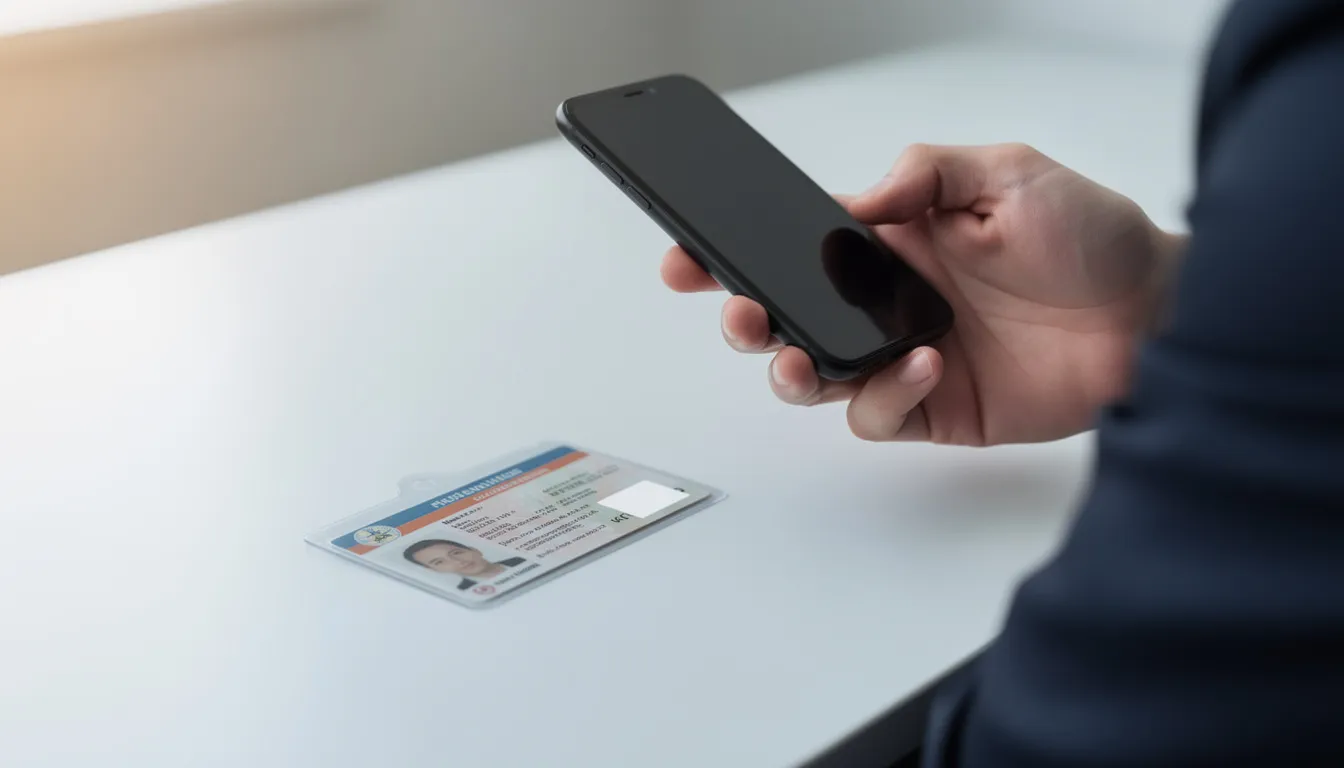
Steps for the pre-application and the appointment at the town hall
The application process consists of several clear steps.1. Online pre-request
- Go to the ANTS (National Agency for Secure Securities) website
- Create your account or log in
- Fill out the secure form
- Get your pre-request number
2. Making an appointment at the town hall
- The pre-request is valid for 12 months
- Choose a town hall equipped with a collection system (not necessarily the one in your home)
- The withdrawal of the card will be done in the same town hall
3. Documents to bring
- ID photo in accordance with current standards
- Recent proof of address
- Old identity card or loss/theft report
- Civil status certificate according to your situation (first title, change of name, etc.)
Fingerprint collection and chip personalization
The biometric part of the process is strictly controlled.
- Electronic collection : During the appointment, fingerprints from two fingers are scanned for people aged 12 and over.
- Chip manufacturing : This collection is essential. Without it, the card cannot be produced.
- Personalization : The biometric data is injected in an encrypted manner into the chip during the production of the title by the national printer authorized by the State.
- Non-preservation option : Via a specific form, you can request that your fingerprints not be kept in the national file. Your card will remain fully functional thanks to the data stored only in the chip.
FAQ — NFC ID card chip
Can I deactivate the NFC chip on my ID card if I don't want to use it?
No, it is not possible to legally deactivate the chip without invalidating your card. Any voluntary alteration (perforation, exposure to a powerful magnetic field) can make the ticket invalid and expose you to difficulties during checks or for your administrative procedures.
Can any application on my smartphone read the NFC chip?
No, only applications specifically designed for this, such as France Identité, can interpret the chip data. The vast majority of consumer NFC applications (payment, transport) cannot access or decipher the secure content of your identity card.
What happens if I lose an NFC ID card?
You must immediately report the loss or theft to the police, the gendarmerie or online. A new card will be issued with a new chip and new electronic identifiers, making the old one permanently unusable for any official or fraudulent use.
Does the NFC chip work abroad for checks?
Yes, the chip can be read by equipment that complies with ICAO standards used in many countries. This greatly facilitates international controls, especially in the Schengen area where the CNIe is fully recognized as a travel document.
Is my ID card without a chip still valid for travel?
Old cards remain valid until their expiry date to prove your identity and travel within the EU. However, they do not allow NFC uses or the creation of a digital identity. Some countries outside Schengen may also prefer recent documents with electronic chips.
Continue reading


Simplify identity verification
A new way to manage identity verification that's easier and more secure.